Particle (Basic ㊦ 347)
A particle which marks a direct object.
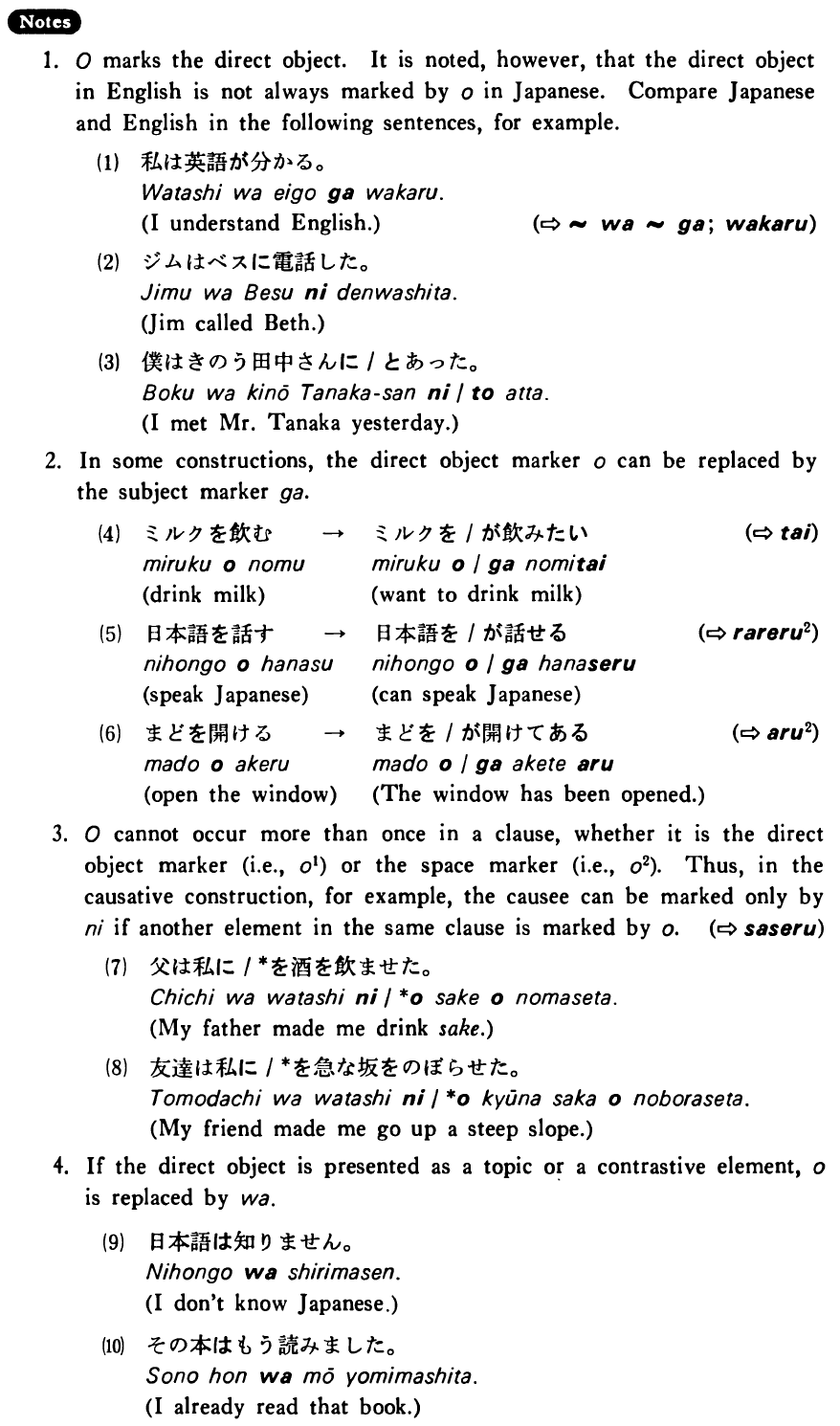
1. を marks the direct object. It is noted, however, that the direct object in English is not always marked by を in Japanese. Compare Japanese and English in the following sentences, for example.
2. In some constructions, the direct object marker を can be replaced by the subject marker が.
| (4) | ミルクを飲む | → | ミルクを/が飲みたい | (⇨ たい) |
| drink milk | want to drink milk | |||
| (5) | 日本語を話す | → | 日本語を/が話せる | (⇨ られる2) |
| speak Japanese | can speak Japanese | |||
| (6) | 窓を開ける | → | 窓を/が開けてある | (⇨ ある2) |
| open the window | The window has been opened. |
3. を cannot occur more than once in a clause, whether it is the direct object marker (i.e., を1) or the space marker (i.e., を2). Thus, in the causative construction, for example, the causee can be marked only by に if another element in the same clause is marked by を. (⇨ させる)
If the direct object is presented as a topic or a contrastive element, を is replaced by は.